


Brassieres, corsets and bustiers: what they are and how they differ
Bustier, bodice and corset are three distinct garments that share a historical origin and a certain common aesthetic, but which work differently, are worn in different contexts and produce different effects on the silhouette.
In this guide, we clarify once and for all what each garment is, how they differ and, most usefully, when and how to wear each one.
What is a bustier?
The bustier is a piece of lingerie or outerwear that covers from the bust down to the waist or upper hips. Its name comes from the French "buste" (bust), which already tells you its primary function: to lift and support the chest while gently defining the waist.
Unlike the corset, the bustier does not reshape the silhouette with strong compression: it enhances it. It's shorter, more flexible, and far more comfortable to wear for hours. Most bustiers have a built-in cup, a hook-and-eye back closure — just like a conventional bra and a wider band that covers the ribcage.
The bustier is lingerie, but with an advantage: many styles are designed to be worn on the outside too, as a crop top with high-waisted trousers or under a suit jacket. It's the most versatile of the three garments.
Types of bustier
Within this category, there are several formats:
-
Underwired bustier with cups: the most structured style, offering real breast support. Ideal for larger busts or occasions where you need support for hours.
-
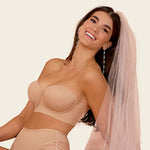
Strapless bustier: designed for dresses and off-the-shoulder tops. It has a non-slip elastic band to stay in place.
-
Bustier with suspenders: a more lingerie-inspired style, with straps to hold stockings. Made for special occasions.
-
Crop top bustier: the most modern and versatile. Can be worn as underwear or outerwear depending on the outfit.
What is a bodice?
The bodice is an outerwear garment, not underwear. It covers the torso from the shoulders to the waist and is typically fitted, sleeveless, and open at the front with lacing or buttons.
The key difference from the bustier is exactly this: a bodice is worn over clothing (or as the main piece of an outfit), while a bustier is lingerie even if it can also be worn on show. The bodice also serves a primarily aesthetic function, defining the silhouette visually, without the bust-support function of a bustier.
Historically, the bodice was for centuries part of traditional and folk dress in many European countries, including Spain, where it remains a recognisable element of regional costume. In contemporary fashion, the bodice has made a comeback as a trend piece, worn over shirts, dresses, or as the main feature of an outfit.
What is a corset?
The corset is the most structured of the three garments and has a function the others don't: actively compressing and reshaping the waist. To do this, it uses boning rigid metal or plastic rods sewn into the inside of the fabric and a back lace-up closure that allows you to adjust the level of compression.
Unlike the bustier, which is flexible and moulds to the body, the corset moulds the body to its structure. That's why it was historically also used as a medical and postural garment, and why it requires a breaking-in period when worn for the first time.
In contemporary fashion, there is a lot of confusion about what a real corset actually is: many garments are sold as corsets when they are really bustiers or corseted tops. The technical difference lies in the metal boning and the internal construction, which in an authentic corset is considerably more complex.
Bustier vs. corset vs. brasier: comparison table
|
Bustier |
Corset |
Bodice |
|
|
Use |
Underwear / outerwear |
Underwear / outerwear |
Outerwear |
|
Function |
Lifts the bust, defines the waist |
Compresses and reshapes the waist |
Aesthetic, visually defines the silhouette |
|
Structure |
Flexible, with built-in cups |
Rigid, with metal boning |
Variable, not necessarily with cups |
|
Length |
To waist or hips |
To hips or below |
Shoulders to waist |
|
Comfort |
High |
Low–medium (requires breaking in) |
High |
|
Occasion |
Daily, date night, party |
Special occasions, fashion |
Fashion, trend pieces |
How to wear a bustier: ideas for every occasion
The Leonisa bustier is the most versatile of the three garments, and it has more styling potential than it might seem:
-
With a fitted dress: under a strapless or plunging-neckline dress, an underwired bustier provides real support without showing a thing. It's the solution for evening or party dresses that need support but can't accommodate a conventional bra.
-
As a crop top: a lace or microfibre bustier with high-waisted trousers is one of the season's most-worn looks. The key is that the fabric reads cleanly as outerwear.
-
Under a blazer or jacket: wearing a bustier in place of an inner top under a blazer gives a sophisticated, polished result. It works particularly well with a tailored, masculine-cut blazer.
How to choose between a bustier, brasier and corset?
The choice depends on three variables: the occasion, the level of support you need and the visual effect you're going for.
-
If you need real breast support for an event, a wedding, or a night out, the underwired bustier with built-in cups is the best option. It delivers the function of a bra with the aesthetic of corsetry.
-
If you're looking for an on-trend look to wear with trousers or a skirt, a bodice as outerwear or a crop top bustier are the most current choices.
-
If you want to visibly sculpt the waist in a pronounced way for a very special occasion, the corset is the only one of the three that genuinely delivers, though it requires a breaking-in period and isn't suited to everyday wear.
At Leonisa you'll find bustiers with built-in cups in lace, microfibre, and seamless fabrics, designed to offer real support and an impeccable finish both as underwear and outerwear. Bras crafted with skin-friendly technology to keep you comfortable for hours, so the only thing anyone notices is you.


